An air fryer deserves consideration when it suits meals you actually cook and can operate safely in the space available. Start with the working footprint, basket and cleaning routine. A litre figure or a headline saving cannot answer those questions.
Check these first
- Measure the working footprint, not just the cupboard.
- Match the basket and batch count to ordinary meals.
- Read the exact model’s ventilation and cleaning instructions.
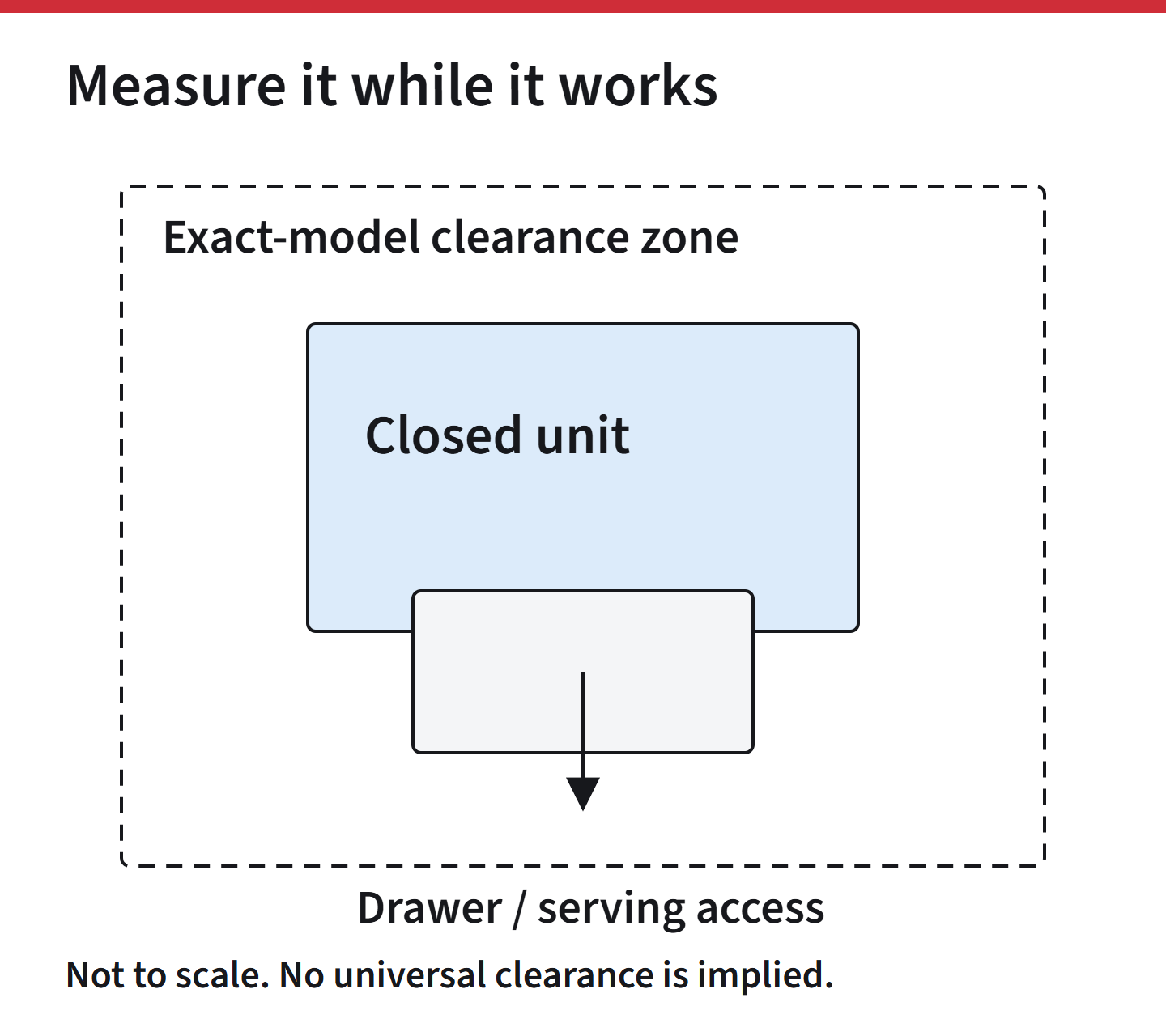
Measure the space while it is working
Record the closed appliance dimensions, then separately check the clearance required by its exact instructions. Allow access to pull out the drawer and handle hot food without blocking another task. Measure the space you will use, not the cupboard in which the appliance might be stored.
- Exact make, model and variant/SKU; manual revision where available.
- Closed dimensions, handle projection and drawer-opening space.
- Required clearances on each side and above; a suitable position and safe cable route.
- Space for lifting, serving, cleaning and putting the appliance away once cool.
A manual-reading example, with a limit
The AF140UK manual held by Marks Electrical specifies at least 15cm above and on all sides. It permits dishwasher cleaning of the drawer and crisper plate, but says not to immerse the main unit or put it in a dishwasher. Follow the instructions supplied with your exact model: this retailer copy is a manual-reading example, not confirmation of the latest revision or a rule for every air fryer.
The linked Ninja AF140UK listing, SKU AF140UKBRN gives conflicting dimensions and weights without explaining the difference. Both sets of measurements are excluded here. Get a confirmed unit measurement for the exact SKU before buying.
Match the basket to a real meal
Advertised capacity is not the same as usable flat cooking area. Think about the shape and quantity of the food you regularly make, and whether a meal would need several batches. A larger unit uses more space; a smaller one may involve more waiting. Neither is automatically the better choice.
Compare the routine, not an imagined saving
Use the oven you already have
Start by asking whether your existing oven already handles the meal conveniently, especially when it uses several trays or dishes. Include the equipment already owned when deciding whether a new purchase solves anything.
Consider an air fryer
Potentially useful for the portions and foods that suit its basket. Check cleaning, batch count and the complete price, including any necessary accessories and delivery.
Wait and observe
Keep a short record of your ordinary meals and the inconvenience you want to remove. If there is no repeated problem, there may be no reason to surrender worktop space.
Safety is part of the fit
Electrical Safety First advises following the instructions, avoiding overfilling and keeping the cable away from heat and the worktop edge. FSA cooking guidance also matters: follow food instructions and check that food is cooked through; do not treat a suggested appliance time as proof. Reheat leftovers only once. The FSA guidance cited covers England, Northern Ireland and Wales.
Give the worktop space a clear job
Buy only when the exact instructions, working space, ordinary portions and cleaning routine all agree. Treat broad energy, running-cost and health claims as claims to examine, not a verdict about your own meals. If the appliance does not solve a recurring problem, keep using the equipment you already have. The same measure-first approach can help with no-drill storage.
Sources and image credits
Sources and checks
Checked 21 October 2026. Electrical Safety First; Food Standards Agency; SharkNinja, manufacturer-issued manual hosted by Marks Electrical; SharkNinja UK. Reference manual: AF140UK_IB_MP_240109_Mv1, printed pages 7 and 12. The product-page measurements are excluded from fit advice.
About the images
Illustrative photo: Puscas Adryan / Unsplash (licence). Original diagram: Rather Good Days.
Read next: Build a task-first kitchen kit.
Research note. A researched buying checklist, not a hands-on model review. It does not establish energy savings or running costs for your meals. How we make recommendations. Details checked 2026-10-21.