The most useful small-kitchen kit starts with what you cook, not a shopping list. Keep the pieces that cover regular meals, check that they fit the hob and cupboard, and buy only to solve a named gap. A smaller kit is worthwhile only if it still lets you cook comfortably.
Put your everyday meals first
- List the cooking jobs your usual meals need.
- Give each useful item a safe, reachable home.
- Add a piece only when it solves a repeated gap.
Start with a few ordinary meals
Write down several meals you genuinely make or intend to learn. For each, follow the sequence from preparing ingredients to washing up and storing anything left over. Count shared equipment if it is available when you need it. This is a planning framework, not a claim about the contents of an RGD kitchen.
| Task | A modest starting option to check | Before adding more |
|---|---|---|
| Prepare ingredients | A suitable knife and stable chopping board. | Can you prepare your ordinary ingredients safely and keep raw/ready-to-eat handling separate? |
| Boil or simmer | A pan and lid that suit the hob and portions. | Check base/heat-source compatibility, capacity, handle clearance and condition. |
| Fry or sauté | A suitable pan and a utensil compatible with its surface. | Does it solve a repeated task the existing pan cannot? |
| Mix, drain or serve | A bowl, sieve/colander or serving item required by your meals. | Can an existing suitable item cover more than one of these jobs? |
| Measure | A method appropriate to the recipe, such as scales or a measuring jug. | Which recipes actually need it? A complete set is not automatically necessary. |
| Store leftovers | Suitable containers, with space for safe cooling and refrigeration. | Do the containers suit their intended food use and cleaning instructions? |
These are functions to cover, not a compulsory basket of six purchases. A person mainly assembling cold lunches needs a different kit from someone baking every week. Do not discard safe, useful equipment simply because it does not match a minimal list.
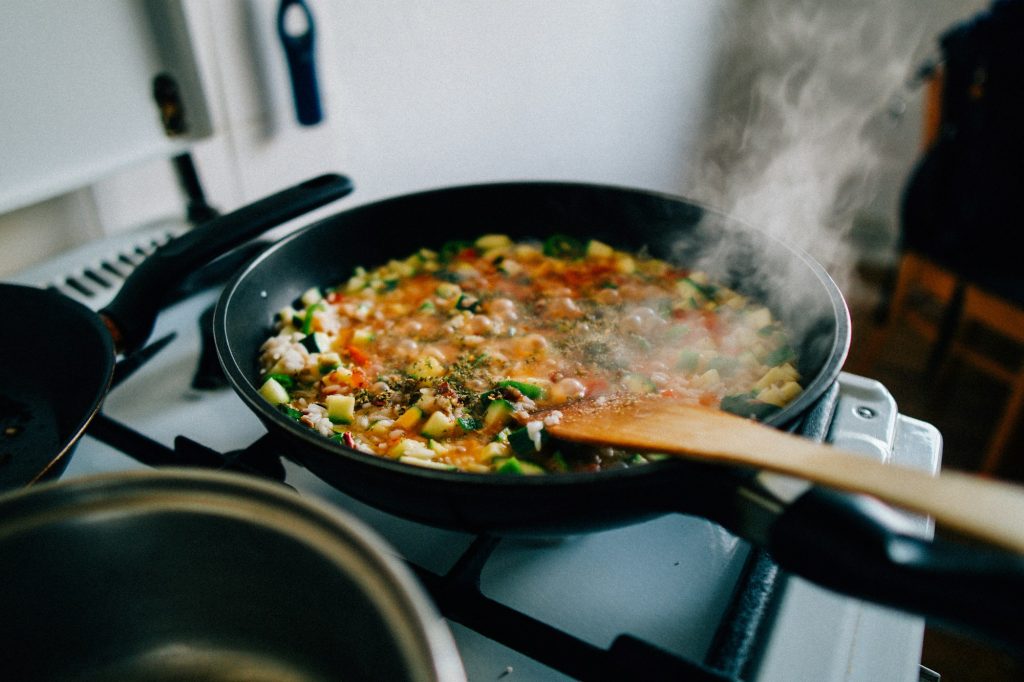
A hypothetical meal audit
For a pasta-and-vegetable meal, trace the jobs: prepare vegetables, heat food, drain if needed, serve and wash up. List the items already available against those jobs. You may discover a repeated bottleneck, such as trying to drain a full pan without a suitable method, rather than a need for several new appliances. This example has not been cooked or timed as an RGD test.
For a baking recipe, read the measurements and method before substituting equipment. A mixing bowl is not automatically an oven dish, and a container that stores food is not automatically suitable for heating it. Check the exact manufacturer’s instructions for oven, microwave, dishwasher and freezer use as applicable.
Give everything a real place
Measure cupboard and drawer openings, including hinges and handles, then check that you can take the item out without dismantling the stack. Include lids and accessories in the space calculation. A set’s piece count can hide the fact that several pieces do the same job while none fits your most-used portion.
For a larger purchase, use the four-footprint measurement checklist. For a new appliance, the air-fryer buying checklist separates the working area from the cupboard where it might be stored.
Make food storage part of the plan
The Food Standards Agency’s chilling guidance recommends a fridge at 0–5°C, cooling cooked food and refrigerating it within one to two hours, and using leftovers within two days or freezing them. Follow stricter food-specific advice where it applies, including for rice. This guidance covers England, Northern Ireland and Wales. Do not let a tidy cupboard plan crowd out safe fridge storage.
Decide between rearranging, borrowing and buying
- Rearrange when a useful item is simply hard to reach. Try the change during an ordinary cooking day.
- Borrow for an occasional task if the item is suitable and available; agree cleaning and return.
- Buy one piece when a repeated task remains difficult and you can name how the item will help. Include necessary accessories and delivery in the cost.
Finish with a sentence: “I need a suitable item for this regular task, and it will live here.” If you cannot fill in the task and the storage place, keep the money and cupboard space for now. For storage methods that leave the walls alone, read no-drill storage, properly thought through.
Sources and image credits
Sources and scope
Researched 21 October 2026. Food Standards Agency: chilling and freezing. Planning examples are editorial suggestions, not records of a Rather Good Days test or event.
Illustrative kitchen photo: Christian Lue / Unsplash (licence); not an RGD kitchen or cooking test.
Research note. A task-first kitchen framework with hypothetical meal examples; no owned or tested product shortlist. How we make recommendations. Details checked 2026-10-21.